Casa Grande Ruins National Monument
Arizona
Tonight
🌔 74% moon
9.1 h fully dark
Crowds
low
Open today
Open
Operating Hours: closed Nov 26 – Nov 26; Operating Hours: closed Dec 25 – Dec 25; Operating Hours: closed Jun 19 – Jun 19; Operating Hours: closed Jul 4 – Jul 4
Entrance
Free entry
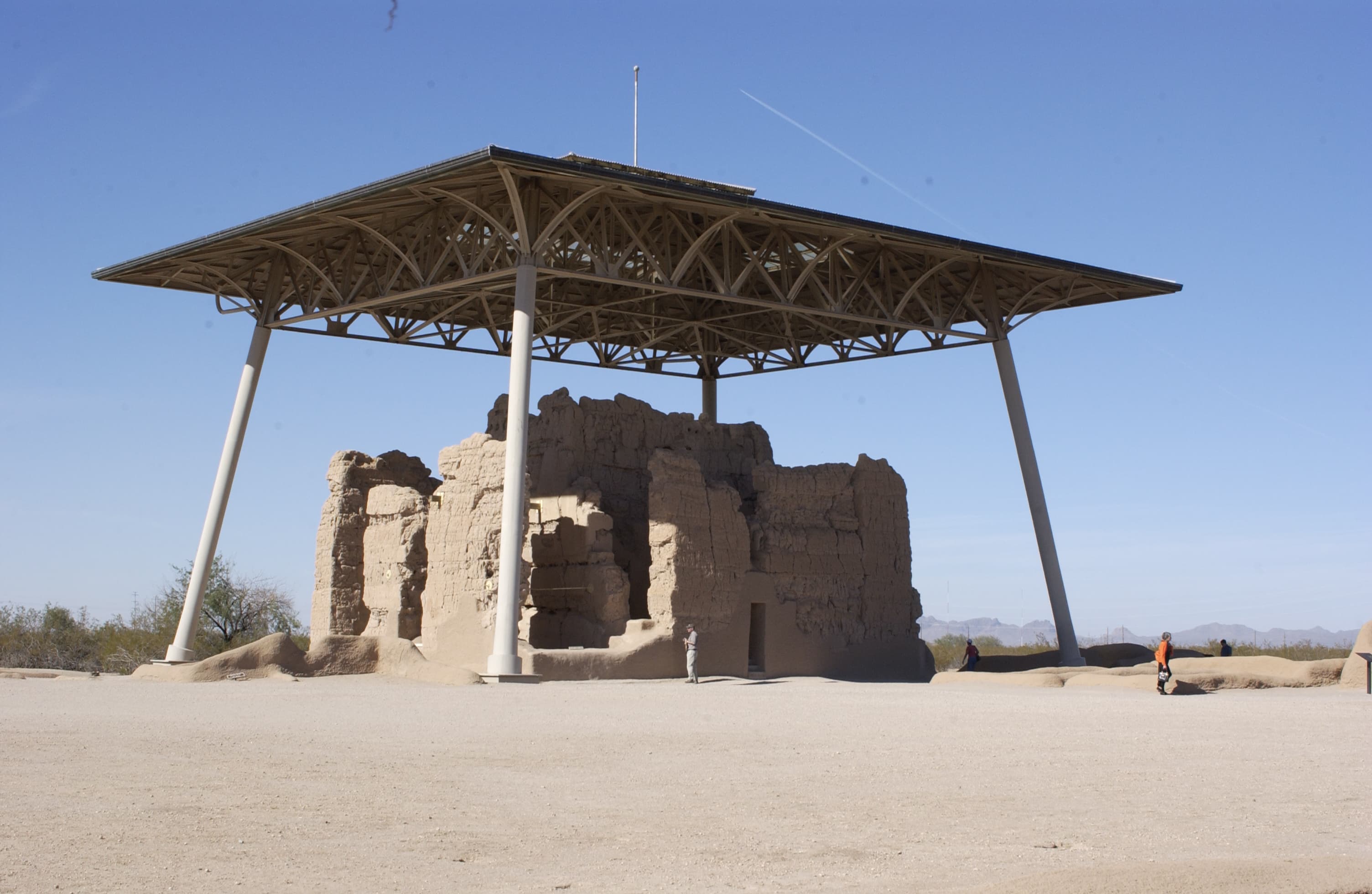
An Ancestral Sonoran Desert People's farming community and "Great House" are preserved at Casa Grande Ruins. Whether a gathering place for people or simply a waypoint marker in an extensive system of canals and trading partners, the structures are a large part of the story of this site. Explore the history and stories of an extended network of communities and irrigation canals.
Activities
Topics
No entrance fee.
Hours & seasons
The monument is open 7 days a week, with the exception of being closed Juneteenth, Independence Day, Thanksgiving, and Christmas. The gate closes 15 minutes prior to closing, with access for exiting the park still available on the outgoing side.
⚠ Operating Hours: closed Nov 26 – Nov 26; Operating Hours: closed Dec 25 – Dec 25; Operating Hours: closed Jun 19 – Jun 19; Operating Hours: closed Jul 4 – Jul 4
Generally open:
winterspringsummerfallHours are reported by the park — verify before you go.
📞 5207233172
✉ cagr_ranger_activities@nps.govConditions
Quietest months (fewer crowds): Jul, Aug, Sep, Oct
Typical crowds: low
Weather now: ☁️ Overcast, 92°F
🌦️ 93°/72°
🌦️ 84°/72°
☀️ 97°/72°
Typical monthly recreation visits · NPS avg 2023–2025 — orange months are the quietest by crowds.
Quietest months
Relative crowds by month — lighter is quieter; ringed months are the calmest by crowds.
Jan
76%
Feb
89%
Mar
100%
Apr
59%
May
36%
Jun
28%
Jul
21%
Aug
18%
Sep
23%
Oct
25%
Nov
44%
Dec
46%
Log a sky reading
Measured the sky with an SQM meter or app? Add your reading (16 = city glow … 22 = pristine). Opt in under “Travelers like you” to share it on the community leaderboard.
Visitor centers
Casa Grande Ruins National Monument
Accessibility
Reported by the park — verify before you go.
Not an official safety source — always defer to NPS.gov and rangers for life-safety decisions.
By the numbers
A visual read on Casa Grande Ruins National Monument — its character, trails, sky, and weather.
Park fingerprint
How this park scores across the dimensions travelers care about.
3-day forecast
Daily high and low temperatures (°F).
People & stories
Figures tied to Casa Grande Ruins National Monument — each spans a cross-park journey.
Eusebio Francisco Kino
— Kino, Missions, MissionaryFrank "Boss" Pinkley
— Pinkley, Boss, NPS HistorySallie Pierce Brewer Van Valkenburg Harris
— Archeologist, Archaeologist, Women In SciencePassport stamps
Mark the stamps you've collected — they show in your memory and along your routes.
🎫 Casa Grande Ruins
🎫 Casa Grande Ruins National Monument
Places to see
Casa Grande Ruins
Audio & media
🎧
🎬
🖼
Learn more
View 2022 recipients of the National Park Service Excellence in Education Awards, which recognize expertise within the field of education.
Each National Park Service (NPS) employee has a unique story. We can't tell them all, but sometimes there's a personal account—like that of Sallie Pierce Brewer Van Valkenburg Harris—that speaks to common experiences. Although her NPS connections ran from 1933 to 1971, many of her joys, challenges, and frustrations can still be recognized in the NPS today. Sallie's story resonates regardless of era, gender, or position. How will it speak to you?
National Park Service (NPS) naturalist Natt N. Dodge spent most of his 30-year-career at parks and monuments in the Southwest. His books, photographs, and motion picture films forever link him to desert ecosystems. It may seem surprising, then, that some of the most interesting photos in his personal collection are of glaciers, crevasses, mountain climbers, and other winter scenes at Mount Rainier National Park.
A lot of articles have been written about the history of the National Park Service (NPS) arrowhead emblem. Many recycle the same content and outdated information that has largely come from the NPS itself. Challenging the traditional story has revealed new sources of information—and two previously overlooked arrowhead designs—that rewrite the arrowhead origin story.
When the climate changes enough, the vegetation communities growing in any given place will also change. Under an expanded bimodal climate zone, some plant communities in western national parks are more likely to change than others. National Park Service ecologists and partners investigated the future conditions that may force some of this change. Having this information can help park managers decide whether to resist, direct, or accept the change.
In 2018, Casa Grande Ruins National Monument received a grant from the Western National Parks Association to better document its cultural resources. This grant included funding for a small project that involved conservation and cleaning of the interior walls of the Great House, a 14th century Hohokam multi-story earthen structure that is the centerpiece of the park, followed by reflectance transformation imaging (RTI) photography.
Although it was built close to 700 years ago, the Casa Grande remains one the tallest structures in the town of Coolidge, Arizona. The Casa Grande is probably the most significant surviving example of Hohokam building techniques and architecture made from caliche, a concrete-like mixture of sand, clay, and calcium carbonate (limestone).
Across the US, changes in water availability are altering which plants grow where. These changes are evident at a broad scale. But not all areas experience the same climate in the same way, even within the boundaries of a single national park. A new dataset gives park managers a valuable tool for understanding why vegetation has changed and how it might change in the future under different climate-change scenarios.
How Casa Grande Ruins National Monument connects
This park's activities, topics, location, and on-the-ground places — one hop in the graph. Drag to explore; click an activity, topic, or related park to follow it.
Park
Activity
Topic
State
VisitorCenter
PassportStamp
Similar parks
Share activities & topics with Casa Grande Ruins National Monument.